Mobile App Development · sub-service
Flutter App Development
One codebase for iOS and Android, built on Google's own toolkit.
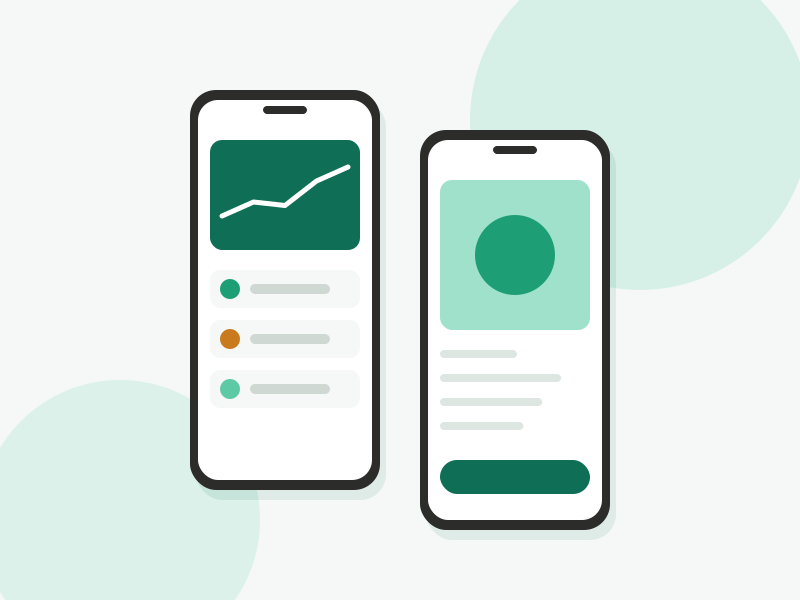
Flutter is Google's toolkit for building apps from a single codebase that run natively on both iOS and Android. Instead of writing one app in Swift for iPhone and another in Kotlin for Android, we write the interface once in Dart, and Flutter compiles it to native code on each platform. For most business apps, that means one codebase to build, test, and maintain instead of two, and new features reach both sets of users at the same time.
Flutter draws its own interface rather than borrowing each platform's standard components. The practical result is that an app looks and behaves the same way on a budget Android phone as on the latest iPhone, which makes it easier to keep a consistent brand and to test thoroughly. We recommend it when that consistency matters more than squeezing out platform-specific native features, which covers most of what we build: customer-facing apps for e-commerce, booking, loyalty, and delivery, and internal apps for field staff and operations teams who need the same tool on whatever phone they carry.
The fit in the UAE and wider GCC is strong because audiences are split across iOS and Android, often within the same customer base. A retailer's loyalty app, a clinic's appointment app, a property management company's tenant app, or a logistics firm's driver app all need to work equally well on both. Many also need English and Arabic, and Flutter's support for right-to-left layouts lets us build both directions from the same screens, rather than maintaining a separate Arabic version.
Delivery starts with scoping. Your strategist and delivery lead run calls to agree the users, the core journeys, the screens, and the integrations, such as payments, maps, push notifications, or a CRM. We also agree what the backend needs to do. Every Flutter app we build talks to a Laravel API built by the same team, so authentication, data, and business logic live in one backend rather than being duplicated inside the app. The result is written up as a scope document and quoted at a fixed price before development begins.
Design comes next, and we design for real thumbs on real screens. Key screens are laid out for small and large phones, both languages where required, and the states that are easy to forget: empty lists, slow connections, failed payments, and denied permissions. Once the flows are agreed, development runs in short cycles with test builds you can install on your own phone, through TestFlight on iOS and an internal testing track on Android.
We test on physical Android and iOS devices throughout the build, not only on simulators. Keyboard behaviour, camera and location permissions, notification handling, and performance on older hardware all differ once a real device is involved, and those are exactly the details users notice. Before release, we run through every core journey on both platforms and fix what we find.
What you receive is a published app on both stores under your own developer accounts, the Flutter source code and the Laravel API in repositories you own, the backend deployed on hosting in your name, push notification and analytics set up, an admin panel for managing content or users where that is in scope, and documentation covering the app's structure, build process, and release steps.
The pitfalls with Flutter projects are rarely about Flutter itself. Treating the app as the whole product and leaving the backend as an afterthought, so data rules end up duplicated in the app. Choosing a third-party package for a critical feature without checking whether it is maintained. Designing only for the latest iPhone and discovering layout problems on common Android models. Forgetting that every change to the app needs a store release, while changes to the API do not, so logic that changes often belongs on the server. And leaving Arabic until the end, when layout direction affects every screen.
Timelines depend on the number of screens, integrations, and platform-specific features. A focused business app with a handful of core journeys usually takes a few months from scoping to store release, including the review period for each store. Larger apps with complex offline behaviour, many integrations, or several user types are planned in phases so something useful reaches users earlier.
There is no published price for Flutter apps, because the cost depends on what the app actually needs to do. Book a scoping call and we will work out the smallest version worth building.
More from Mobile App Development
-
React Native App Development
JavaScript and React, compiled down to genuinely native iOS and Android apps.
Read -
Mobile App MVPs
The smallest working app that lets real users tell you what to build next.
Read -
App Store & Google Play Launch
Submission, review, and listing setup for both stores, handled for you.
Read
How we deliver
How we deliver Flutter App Development.
Your strategist scopes the work, the delivery lead ships it, and you see progress in the same monthly report as the rest of your account.
Guides on this topic
All insights-
Comparison
SEO agency vs freelancer vs an in-house hire in the UAE
A freelancer suits one well-defined task, an in-house hire suits a business where SEO is a full-time priority, and an SEO agency...
-
Comparison
Shopify vs WooCommerce for UAE businesses
Choose Shopify if you want a fully hosted store with less technical maintenance, and choose WooCommerce if you want full ownership of...
-
Comparison
WordPress vs custom website: how to choose
Choose WordPress for a content-managed site you can launch quickly and affordably, and choose a custom build, such as one on Laravel,...
Ready when you are
Your customers are searching in the UAE. Make sure they find you first.
A free audit of your technical setup, content, and backlinks, reviewed by a real person within 2 business days. No card, no obligation. Just a straight answer on what's working and what isn't.